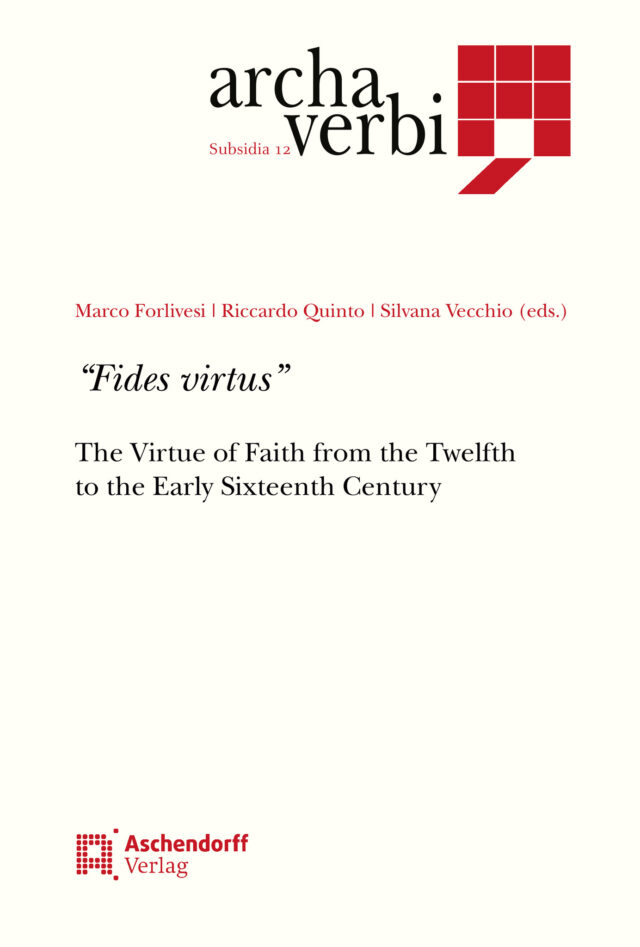
Archa Verbi. Subsidia · Band 12
"Fides virtus"
The Virtue of Faith from the Twelfth to the Early Sixteenth Century
Hrsg. von Marco Forlivesi, Riccardo Quinto, Silvana Vecchio
84,00 € inkl. MwSt., zzgl. 3,00 € Versand ab 20 € versandkostenfrei (DE)
In Ihrer Bibliothek · gekauft am
Jederzeit in Ihrer Bibliothek unter Mein Konto.
Direkt vom Verlag – seit 1720 in Münster.
Tracing the history of the doctrines on the nature of faith is an immense endeavour. What the Middle Ages and the Renaissance felt on this subject resulted in a huge literary production, involving an extensive number of authors and taking a variety of themes into account. Compared to this vast literature, the contributions constituting the present volume have a limited and defined scope: they aim to analyse 12th- to 16th-century doctrines specifically concerned with faith as a theological virtue. In this perspective, a number of recurrent problems of exegetical, theological, pastoral, or political nature have been identified. Among the most significant challenges faced by medieval and Renaissance authors, one can notice the attempt to hold together two key-features defining faith: on the one hand, the gnoseological "weakness" of faith, which is considered an assent, maybe a sort of obscure understanding, yet not a sight, either of God or of anything else; on the other hand, the absolute "certitude" and "truth" of faith, which were the matter of no controversy. These features gave rise to a crucial gnoseological problem, that is to say, how a person adhering to the allegedly true and undeniable faith can really know that his/her faith is nothing but a mere opinion. Another exemplary case concerns the reasoning on faith’s political and ecclesiological dimension. In this respect, faith is not seen primarily as an intellectual attitude, but rather as a sort of theological-anthropological prerequisite, generating, when present, a person’s belonging (or, when absent, a person’s not belonging) to the political community of believers. Precisely the political dimension of faith makes the problem of infidelitas so immediate and dramatic for many medieval and Renaissance authors, and elicits the will to reduce the extent of infidelitas and the number of infideles thanks to a widespread work of predication, persuasion and repression. Facing problems like the ones now recalled, medieval and Renaissance authors, in a supreme effort to solve them, begot the kaleidoscopic variety of differing theories that is the subject of the present publication and that – paradoxically as it may seem – paved the way for medieval, Renaissance and modern discourses on relativism and toleration.
Bibliographische Angaben
- Reihe
- Archa Verbi. Subsidia, Band 12 (2014)
- Auflage
- 1. Auflage
- Erscheinungsdatum
- 23.06.2014
- Umfang
- 524 Seiten
- ISBN (gebunden)
- 978-3-402-10228-2
- Verlag
- Wissenschaft und Forschung
- Maße
- 17 × 24 cm
Aus derselben Reihe
-
-
-
-
-
-
-
-

-
-
-
-
-